




Catalog of Developments
Catalog of developments (printed version)
HoloLink – Holographic Telepresence platforms and terminals
Annotation:
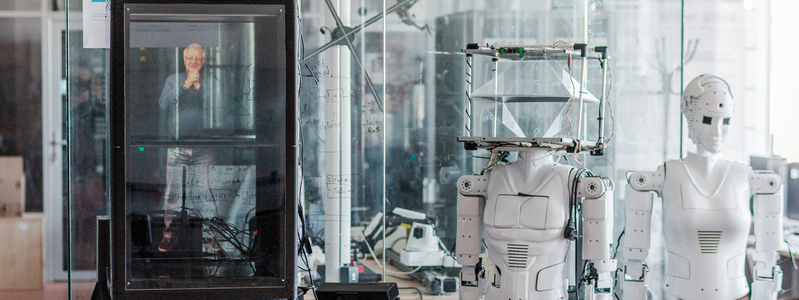
The Hololink platform is a conference call using user holograms, which implements the technology of transmitting 3D images of users to a point cloud.
Hololink terminals based on volumetric technology are capable of providing:
- Holograpgic telepresence for Internet users (3D conferencing).
- Communication for users with disabilities (inlimited sign language in the form of 3D holograms).
- Creation of digital avatar models for further reproduction in the form of a hologram based on virtual point cloud technology.
- Hololink terminals of various sizes (including for the actual height of the user).
The HolNetVerse project has become one of the winners of the prestigious UN international competition dedicated to the metaverse.
The pilot project "Holographic University" is being implemented at St. Petersburg State University named after Prof. M. A. Bonch-Bruevich: 12 desktop-type personal terminals (for reproducing 3D content of educational courses), one growth terminal for a hologram avatar of a remote teacher.
The Telepresence Suit

Andrey
Evgenievich

ext. 12-65
Annotation:
The MEGANETLAB 6G research laboratory at St. Petersburg State University has developed a telepresence suit with kinesthetic feedback and a prototype of a Metaverse to study the problems of interaction between the digital and physical worlds.
Features of the designed suit:
- Force feedback.
- Reading the user's movements (all degrees of freedom of the upper extremities).
- Transfer of sensations of heat and cold.
- First-person view (XR, VR)
- Algorithms for analyzing user movements.
- Avatar based on "digital twin" technology.
- Recording the user's movements (with the possibility of subsequent analysis to adjust digital skills).
- The ability to interact with the Metaverse.
Wireless Synchronous Mesh Network Protocol for IoT Devices


Andrey
Sergeevich
ext. 12-65
Annotation:
The protocol provides the basis for building reliable wireless synchronous mesh networks with a large coverage area and high energy efficiency. In addition, it plays an important role in organizing and ensuring efficient and scalable communication between multiple devices.
A large coverage area (significant communication range) is provided using a mesh topology. In such networks, each device is a network node, and one network coordinator is sufficient for management and routing.
The system of identification of unmanned aircraft systems

Andrey
Sergeevich
ext. 12-65

Alexander
Alexandrovich
Annotation:
The identification system allows you to identify and monitor the flight of unmanned aircraft systems in real time. It is integrated with external monitoring and flight management services.
The system consists of a server part and trackers — miniature modules that are installed on drones and send unique identifiers through the infrastructure of mobile operators. The DOA (Digital Object Architecture) digital Object Architecture is used for identification.
Patent for invention No. 2860177 dated 04/14/2026 was obtained.
Technical specifications:
- Built-in module: LTE/GSM.
- Radio interface: GSM/GPRS/EDGE 900/1800 MHz.
- GNSS Receiver: GPS/GLONASS/Galileo/QZSS.
- Weight: not more than 75 g.
- Operating temperature range: -40°C to +80°C.
On-board device identification system for unmanned aircraft systems based on the architecture of digital objects
Andrey
Sergeevich
+7 (812) 305-12-69,
Annotation:
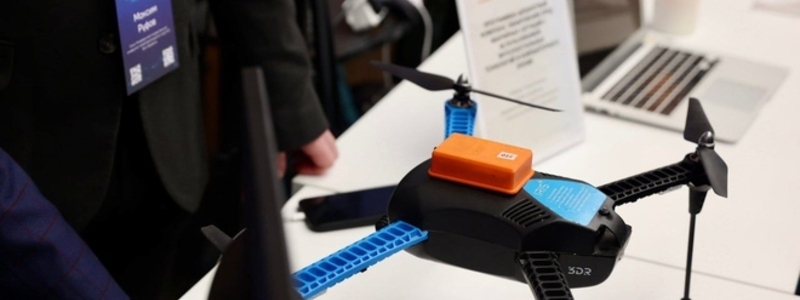
The on–board device of the Identification System (BPSI) is a part of the identification and traceability system for unmanned aircraft systems (UAS) based on the Digital Object Architecture.
The BPS is an electronic device with a unique identifier containing a microcontroller, a cellular radio modem, sensors (barometer, accelerometer, gyroscope), and an autonomous battery. The BPSI is installed on the UAS, registers and transmits information about the coordinates and flight characteristics.
A video codec stand for first-person control of unmanned aircraft systems when transmitting information via satellite communication channels

Alexander
Alexandrovich
Annotation:
The video codec stand is designed for a comprehensive assessment of the transmission of a video stream from an unmanned aerial vehicle (UAV) to an external pilot's station in the FPV (First Person View) mode via satellite communication channels.
The system allows you to study the influence of video codec parameters and channel characteristics on image quality and transmission delays, which is critical for effective UAV management.
The stand is intended for developers of video surveillance systems, UAV operators and telecommunications specialists working with data transmission via satellite channels.
Technical specifications:
Flexible architecture: includes a video stream generator (APIX 22ZBox/M8 IP camera), a PC encoder with support for standard and neural network codecs, a PC decoder and analysis tools.
Powerful hardware base - Two PCs with Linux Mint 22.1 x86_64, AMD Ryzen 7 5700G processor and NVIDIA GeForce RTX 4080 SUPER graphics card for high-performance video processing. Using a non-programmable switch for a stable connection.
Alexey
vicerector.sc@sut.ru
Annotation:
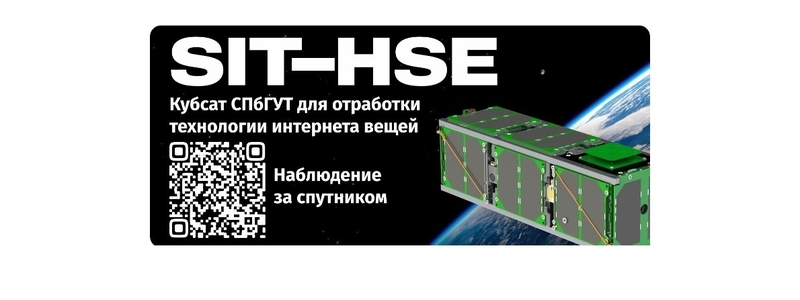
The small spacecraft is designed to test the technology of the Internet of Things based on the LORA protocol, as well as to conduct surveys of the Earth.
Students of the St. Petersburg State University of Telecommunications named after Prof. M. A. Bonch–Bruevich will participate in experiments and analyze the results.
IoT technology opens up new opportunities for the whole world and is important for applications in various fields: housing and communal services, transport, agriculture, industry, and most importantly, communication with remote areas.
Technical specifications:
- Spacecraft name: SIT-HSE.
- NORAD ID: 61763.
- Call sign: RC2336.
- Frequencies: 401-402 MHz, 8175-8215 MHz.
- Size: 3U.
- Weight: 3.2 kg.
- Payload: IoT, camera.
- Purpose: IoT, remote sensing.
- Platform: SPUTNIX LLC.
- Launch: November 5, 2024, Vostochny Cosmodrome (NSSDC ID: 2024-199).
- Orbit: MTR, inclination 97.38°.
- Launch vehicle: Soyuz-2.1b with RB "Frigate".
Adaptive 8-element antenna array

Evgeniy
Ivanovich

Konstantin
Olegovich

Igor
Andreevich
ext. 1495
Annotation:
The device is designed to organize mobile communications as base station antennas, hybrid communications as ground station antennas, and communications with UAVs.
It contains an antenna array, analog RF path amplifiers, a rotary device, and a processing unit on a debugging board.
Technical specifications:
- Design: single-board.
- Food: 12V for RF path amplifiers, 220V for the board.
- The converter is included in the package: -220 V / =24 V.
- Power consumption: no more than 5 watts.
- Weight: not more than 5 kg.
- Operating temperature range: -20...+40°C.
- Service life: at least 5 years.
- Average failure time: 25,000 hours.


Sergei
Victorovich
ext. 21-34
Аннотация:
The software and hardware of the stand make it possible to obtain a volumetric radiation pattern, antenna polarization characteristics, and a polarizing radiation pattern in a wide frequency range.
The stand is a visual aid for working with complex systems and is used in laboratory and research work.
Technical specifications:
- The engine used ensures azimuth and roll positioning accuracy of at least 0.5 degrees.
- The frequency range is 1-8800 MHz.
- The variable frequency band is 20 Hz – 1 kHz.
- The dynamic range of transmission coefficient measurements is more than 80 dB.
- The scanning speed is 500 dots/s.
Omnidirectional sound source


Olga
Andreyevna
Annotation:
A two-way omnidirectional sound source based on domestic speaker heads is designed to measure the acoustic parameters of rooms in accordance with GOST R ISO 3382-1-2013 and GOST R 54579-2011 (ISO 18233:2006).
Technical specifications:
- Sensitivity: 90 dB/W/m.
- Effectively reproducible frequency range, Hz: 33-11360 Hz.
- Unevenness of the frequency response: 10 dB.
Annotation:
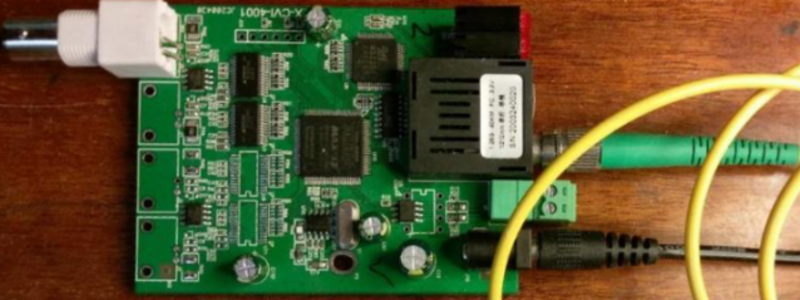
The device is designed to transmit analog video and control signals over a fiber-optic communication channel with minimal delay.
It contains two optical transceivers, an FPGA for multiplexing a digitized video signal with a UART signal, an ADC/DAC IC, and an RS-485 interface driver IC.
Technical specifications:
- Design: two single-board transceivers.
- Power supply: 5 V DC. current.
- Power consumption: no more than 5 watts.
- Weight: not more than 0.25 kg.
- Operating temperature range: -40°C to +55 °C.
- Service life: at least 10 years.
- Average failure time: 25,000 hours.
VANET 2.0 software package

Pavel
Vladimirovich

Andrey
Gennadevich
Annotation:
Process modeling of intelligent transport systems based on Vehicle-to-Everything (V2X)
Technical specifications:
Modeling of V2X interactions:
- Reception/Free format message transmission (can be modified to meet industry standards).
- OSM map integration (graph map of locations).
- Calculation of signal attenuation (by default using 3GPP models, but can be modified).
- Placement of roadside infrastructure facilities (RSU, ES/MEC).
- Dynamic route adjustment, traffic. Using mobile RSUs (mRSU). Calculation/Visualization of the load on the RSU network with the subsequent possibility of balancing it.
- Clusterization of RSU. Caching of information (on OBU, RSU, mRSU and ES/MEC). Calculation of losses in the simulated system.
Laboratory bench for recognition of radio storage devices and stress test analysis of wireless data transmission systems


Stanislav
Igorevich
ext. 1149

Nikolay
Leonidovich
ext. 1149
Annotation:
The laboratory complex demonstrates the principles of building trusted data transmission channels. The stand presents typical integration schemes, information protection mechanisms and examples of implementation of secure protocols based on embedded systems.
There is a tester analyzer of packet networks, which is included in the state register of measuring instruments, designed to monitor and diagnose the quality parameters of modern communication systems based on IP technology and to check the quality of customer service.
Technical specifications:
- Raspberry, Arduino, Linux VM, laptop. The main layout is a traffic analyzer.
- Interfaces: two 10/100/1000 Mbit/s RJ45 ports; two 1000 Mbit/s SFP sockets; one USB port for control from a personal computer; one port for 10/100 BASE-T remote control with RJ45 connector; color graphic liquid crystal display with a resolution of 320×240 pixels, with adjustable backlight brightness providing the ability to work in bright sunlight; film keyboard.
- Weight and size characteristics: weight 0.6 kg; The dimensions are 196×100×40 mm.
- Power supply: from the mains with a voltage of 220 – 230 V and a frequency of 50 – 60 Hz via an AC adapter; Powered by six AA batteries, battery life of at least 6 hours; battery type NiMH; battery charging time is no more than 12 hours.
Palladium-free alloy membranes for the extraction of ultrapure hydrogen


Evgeny
Yurievich
Alexander
Annotation:
For the first time in the world, vanadium alloy membranes have been created that are suitable for practical applications:
- thin-walled tubular membranes with micron palladium coating on the outer and inner sides and sealed welded junctions to stainless steel,
- assemblies of such membranes.
Technical specifications:
- Tubular membranes: diameter 6 mm, wall thickness 120-200 microns, length up to 300 mm.
- Operation in various hydrogen-containing gas mixtures with a total pressure on the inlet side of the membrane up to 12 bar, a partial pressure of hydrogen at the inlet of 6 bar, and a pressure of hydrogen at the outlet of 1 bar.
- The density of the penetrating hydrogen stream is more than 0.5 cm3/cm2.
- The purity of hydrogen at the membrane outlet is 99.999999997%.
Prototype of a vehicle traffic management system for a smart city


Igor
Borisovich
ext. 11-67
Annotation:
Based on a multi-agent approach, a model is being developed that takes into account the loading of a multi-lane intersection and its topology; controlled by traffic lights, for which section switching timings are determined.
The developed model can use several methods for optimal intersection management.
Technical specifications:
Laptop with software installed: Windows 10, AnyLogic 7.8.
Acousto-optical light flow switch
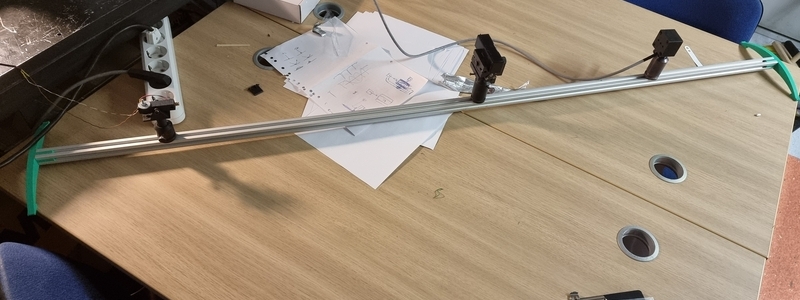

Annotation:
The exhibition demonstrates the principle of acousto-optical modulation, the features of light diffraction on an acoustic array, and the ability to control a laser beam. Practical applications in communication systems, laser spectroscopy, signal processing and photonic technologies are considered.
Technical specifications:
Radiation source:
- Type: optical quantum generator.
- Wavelength: 650 nm.
- Output power: up to 5-50 MW.
- Operating mode: Continuous (CW).
Acousto-optic modulator (AOM):
- Crystal material: Quartz.
- Central excitation frequency: 40-80 MHz.
- Operating frequency range: ±5-10 MHz.
- Diffraction efficiency: up to 70-90%.

Annotation:
The demonstrated element is supposed to be used in an antenna array for satellite communications.
Technical specifications:
- The demonstrated element of the antenna array was measured in the range of 8-18 GHz.
- In the specified frequency range, a single element had two operating bands in the region of 12 and 15 GHz.
- The operating characteristics of the element showed a serious dependence when changing the power supply method.
A hardware and software complex for the rapid detection of non-standard situations using computer vision
Vladimir
Ivanovich
Annotation:
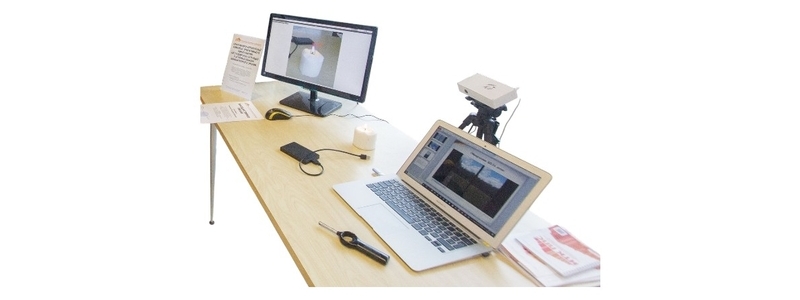
An operational test stand for the rapid detection of pre-emergency situations (flames, smoke, short circuit in electrical /network, displacement of objects), enemy UAVs, etc. on a computer (machine) vision platform using artificial intelligence elements.
Technical specifications:
- Type: Computer program (IBM compatible PC).
- Language: Python 3.10+.
- OS: Linux Ubuntu 20.04+.
- Volume: 6 GB.
- Architecture: Web interface (FastAPI, WebSocket).


Galina
Victorovna

Sergei
Viktorovich
Annotation:
The stand is designed for conducting laboratory and practical classes related to the study of industrial automation devices and devices.
Technical specifications:
- Construction: modular.
- Food: = 24 V.
- The kit includes an industrial computer, two touch-screen displays, an interface converter, various sensors of physical quantities, a clock counter, and industrial timers.
Galina
Victorovna
Sergei
Viktorovich
Annotation:
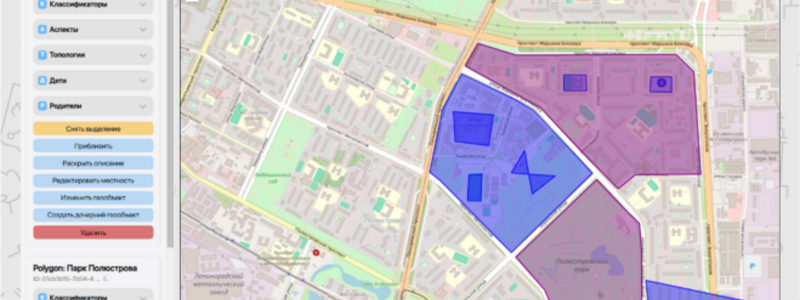
The prototype is intended for research in the field of multidimensional geoinformation modeling and the creation of digital counterparts of natural and man-made geosystems.
Technical specifications:
- Technologies: ASP.NET Web API, GeoJSON, Entity Framework Core, React.
- Methods: methodology of multidimensional modeling, Domain Driven Design.
- Programming language: C#. GIS Platform: Leaflet, OpenSteetMap.
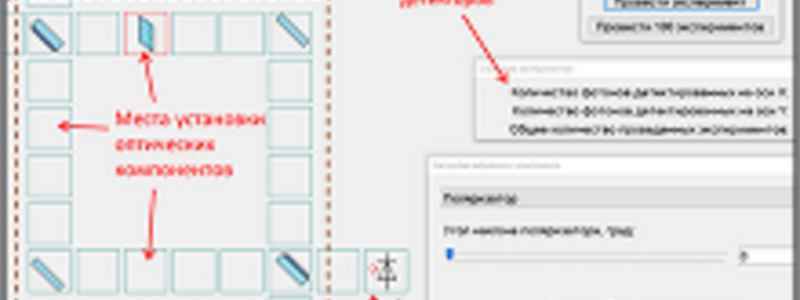
Virtual laboratory complex based on the Mach-Zehnder interferometer for the study of quantum phenomena

Maria
Sergeevna
ext. 1269
Gleb
Ruslanovich
ext. 1269
Annotation:
The NB-PLC modem is designed for low-speed transmission of information over low- and medium-voltage electrical networks as part of systems for electricity metering, security and fire alarm systems, monitoring the condition of facilities, etc.
It contains a modem operating over power transmission lines and data input/output interfaces from sensors located at the monitoring facility.
Technical specifications:
- Frequency ranges: Cenelec A (34-90kHz), Cenelec B/C (95-140kHz), FCC (150-490 kHz) and FULL (34-490 kHz).
- Standards: G3‑PLC, IEEE 1901.2.
- Interfaces: RS-232, RS-485, Ethernet/IPv4, mini-USB.
- Protocols: MODBUS, IEC‑870‑5-101 , IEC‑870‑5-104 .
- Number of modems in the network: up to 1000 pcs.
- Electrical connection: capacitive or inductive.
- Food: constant, 24...30 V.
- Power consumption: no more than 3.5 watts.


Dmitry
Andreevich
Annotation:
The NB-PLC modem is designed for low-speed transmission of information over low- and medium-voltage electrical networks as part of systems for electricity metering, security and fire alarm systems, monitoring the condition of facilities, etc.
It contains a modem operating over power transmission lines and data input/output interfaces from sensors located at the monitoring facility.
Technical specifications:
- Frequency ranges: Cenelec A (34-90kHz), Cenelec B/C (95-140kHz), FCC (150-490 kHz) and FULL (34-490 kHz).
- Standards: G3‑PLC, IEEE 1901.2.
- Interfaces: RS-232, RS-485, Ethernet/IPv4, mini-USB.
- Protocols: MODBUS, IEC‑870‑5-101 , IEC‑870‑5-104 .
- Number of modems in the network: up to 1000 pcs.
- Electrical connection: capacitive or inductive.
- Food: constant, 24...30 V.
- Power consumption: no more than 3.5 watts.
A specialized agent for a self-organizing network for collecting meteorological data in mountainous areas based on LoRa technology

Rinat
Igorevich
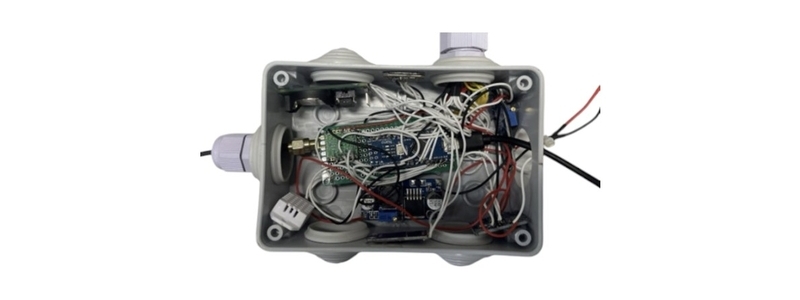
Annotation:
The device is designed to collect meteorological data offline in Arctic weather conditions and transmit the collected information, as well as relay the received information. It contains a number of sensors, a transceiver and a computing module. The number of sensors and their appearance may differ from the agent version.
Technical specifications:
- Design: single-board.
- Power supply: battery, 3.7 V.
- Range without relay: up to 1.5 km.
- Weight: not more than 0.25 kg.
- Message transmission parameters: RSSI up to -110 dBm, SNR up to -12 dB.
- Transmission frequency: 868.8 MHz.
- Operating temperature range: -40°C to +40°C.

Annotation:
Speech purification from quasi-stationary acoustic noises (transport, street, office) is performed using a digital adaptive filtering algorithm in the frequency domain. The algorithm is implemented in the form of a noise reduction device (SHPU) designed for use in communication equipment operated in conditions of high ambient acoustic noise. For example, one of the variants of the silo is used in manned space exploration.
Technical specifications:
- Construction: a mezzanine for the Customer's fee.
- Power supply: constant, 3.3 V.
- Operating temperature range: -40...+80 °C.
Automated monitoring complex for cellular communication systems of 2G-4G standards

Boris
Mavrovich
antipin.bm@sut.ru
Annotation:
The cellular network monitoring system is designed to scan and analyze base stations and cellular network nodes in the availability zone. The collected information can be presented in the form of tables or reports, as well as displayed on a map.
Technical specifications:
- Construction: single-board.
- Food: constant, 12 V.
- The converter is included in the package: -220 V / =12 V.
- Power consumption: no more than 5 watts.
- Weight: not more than 0.25 kg (without PC).
- Operating temperature range: from 0°C to +40 ° C.
SDR-MIMO System Demonstrator


Grigoriy
Alexeyevich

Nikita
Victorovich
Annotation:
The demonstrator is designed for studying, prototyping and evaluating MIMO algorithms, positioning and beam control of the antenna array pattern.
It contains four NI USRP 2932 SDR cards, a Metronome-PTP-1U-V2 exact time server, a Metronome-T translator, and a PC with ACCORDING TO Matlab, there are eight pin antennas.
Technical specifications:
- Frequency range: 400 MHz – 4.4 GHz.
- Bandwidth: 20 MHz.
- Duplex: full.
- Number of transmission antennas: 4.
- Number of reception antennas: 4.
- Synchronization method: 1PPS and 10 MHz signals.
SDR-Radio link control Demonstrator using xApp in srsRAN

Grigoriy
Alexeyevich
Annotation:
Demonstration of the possibility of using third-party radio network management (xApp) applications in intelligent radio network controllers (RIC) in the Open RAN concept.
It contains logical elements of the 5G network, Near-RT-RIC, two USRP B210 SDR cards.
Technical specifications:
- The decision-making time is from 10 ms to 1 s.
- The ability to work completely virtually.
- The possibility of using DL/ML to distribute BS radio resources.
- Managing multiple BS.
- Implementation of Near-RT-RIC as a network function.
SDR-Wi-Fi Signal Analyzer

Egor
Sergeevich
Annotation:
The SDR Wi-Fi signal analyzer implements the formation of a database for determining the location of devices indoors based on the signals of Wi-Fi access point beacons by detecting Wi-Fi access points, analyzing service frames to determine the MAC address, channel width and equipment manufacturer in the 2.4 and 5 GHz bands of different generations of devices, forming a radio map of levels RSSI signals.
Technical specifications:
- Number of channels: 2 TX, 2 RX.
- Bit depth: 12-bit DAC/ADC.
- Carrier frequencies: TX From 325 MHz to 6 GHz.
- Carrier frequencies: RX From 325 MHz to 6 GHz.
- Duplex support: TDD and FDD.
- Bandwidth: From 200 kHz to 56 MHz.
SDR-LTE Signal Analyzer Demonstrator
Annotation:
The signal analyzer is designed to determine the location of a user device that is not a network subscriber by analyzing the broadcast signals of the LTE BS standard.
Technical specifications:
- Transceiver: AD9361.
- Frequency range: 70 MHz – 6 GHz.
- Number of channels: 2TX / 2RX.
- Bandwidth: up to 56 MHz.
- Food: constant, 5 V.
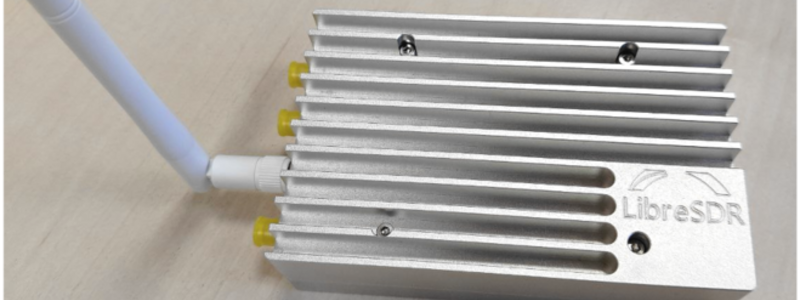
It contains the LibreSDR SDR receiver and a computer with MATLAB software.